Wednesday, March 7, 2012

5. Examples of real robots.

 
Military robots.
 
Big Dog.

Military uses robots are developed the most in the United States. A prestigious company called Boston Dynamics who works for the government to investigate in military technology has be making one of the most useful robots to those objectives: Big Dog.

Big Dog is a robot designed to support marines or soldiers in the forest, in the jungle, in the snow, etc, by transporting onto it their things, gadgets, gums, weapons, food, everything they would need during a military expedition. It should have a better motion system than other vehicles like cars, lorries or tanks.

The robot was made imitating the motion systems of a four leg animal, as a dog. It has on board whatever it needs: power, actuators, control systems, sensors and communication systems. It works with a combustion engine; to its displacement, Big Dog has hydraulic actuators with oil and these ones have some aeronautical using components which give it quality; all its legs have sensors that control the position of the robot and calculates the force of the movement. It is able of jump, run and walk over every surface and inclination, in addition, it has a balance system even done, that gives him the power to correct its walking if it falls upon something or similar.

More sensors that Big Dog has are its LIDAR, stereo vision system, GPS or Ring Laser Gyro. Sight systems in Big Dog permit it scan the terrain in a radio of 30 metres, detect every obstacles, make a three-dimensional image of the area (this function in a radio a 4 metres only) and classify and guess where some obstacles could be.

The robot can maintain its body posture by controlling the different movements of its body: its standing, its lateral balance and measuring the level of contact with the ground.
On board Big Dog´s computer has a Pentium processor, a computer PC 104, an operating system QNX and it is programmed in C++.

Big Dog is capable to follow humans during a walk and obey their orders. The person who would lead Big Dog has to wear an OCU, an Operator Control Unit, which consists in a head mounted display, a 900 Mhz antenna, HMD electronics, a steering controller, a personal computer, and a 900 Mhz radio device.

Big Dog has got another descendant called AlphaDog, the most advanced robot of this series. It is capable to develop all Bog Dog´s motion capacities, but it is more than twice bigger and it is much more agile, fast and stronger. In addition, it is capable to wake up after falling down. Boston Dynamics has published videos of its operation that will surprise the reader in such an outstanding way!

Exploration robots (Space robots).
Curiosity.
Curiosity is the latest Mars exploration rover created by the National Aeronautics and Space Administration NASA .

The real name of this robots Mars Science Laboratory (MSL), but it is often called Curiosity.

It was sent to Mars the 26th of November 2011.

This robot has specific exploration functions when it will land. It is destined to discover it has been alive beings in Mars, determine the climatic conditions of Mars, study its geology and get ready a possible human travel to this planet. It is clear that its goal is getting information.

Curiosity is a sort of robot called rover. Its weight is 930 kilograms in the rough and holds about 80 kilograms more in investigation devices. On Mars surface it will be able to move at a speed of ninety meters an hour and pass over 75 centimetres high obstacles.

It works with a nuclear energy battery that is a Radioisotopes Thermoelectric Generator (RTG) which works using plutonium, producing two kilowatts and a half every day.
Curiosity has a complex vision systems that consists in a group of video cameras: one of them is “MastCam “, that is capable of take images of different spectres, full colour images and three-dimensional ones; “Mars Hand Lens Images” that is camera put on a robotic arm of Curiosity to catch microscopic images of the ground of Mars; “Mars Descent Imager” which will be employed to take pictures of the planet during the robot´s capsule landing; “Hazard Avoidance Cameras” that will detect every risks during the robots expedition; and “Navscams”, the navigation cameras which are situated on a mast on the robots back.

The other instruments are spectrometers, radiation systems, environmental sensors and atmospheric sensors:
 
Spectrometers are: APXS, Alpha Particle X-Ray Spectrometer that will measure the quantity of chemical elements in the rocks and other things by, simply, emitting X-rays a sort of electromagnetic radiation- and detecting the characteristic answer of the surface; ChemCam which is a laser producer that throws a laser ray that vaporizes certain materials and then identify the elements by emission of plasma generated; CheMin -Chemistry and Mineralogy instruments-; and SAM -Sample Analysis at Mars instrument-. Radiation detectors are the Radiation Assessment Detector (RAD) and the DAN. Environmental sensor is the REMS, the Rover Environmental Monitoring Station , that has a device developed by Spanish government called the CAB (the “Centro de Astrobiología”). Finally, the atmospheric sensor is called MEDLI.


Curiosity has inherited many displacement devices from its predecessor, Mars Exploration Rover. It have a six wheels drive, rocker-wagon suspension system and all navigation machines (Navscams and other ones). The mobility system is quite similar to the predecessor and is compact.

Androids, humanoid structure robots: “Asimo” and “Petman”.
Asimo.
Asimo, “Advanced Step and Innovate Mobility” robot, is an android -a robot similar to human beings- developed by the multinational Japanese company Honda in 2000.

Asimo is a robot made for people relationships: interacting with humans, helping them, etc. However, the difficulties that the complexity of humans behaviour supposes make this robot not able to do its work at all, then, it is employed to advertisement labours. It is one of the most advanced human robots in the world because it imitates many human movements as running, walking, jumping, crawling or turning. Asimo has some Artificial Intelligence appliances like identifying and catching objects, understanding and answering oral orders and recognize people faces. It has been added a communication system (RC IC) that permits him know where people are without looking at them.
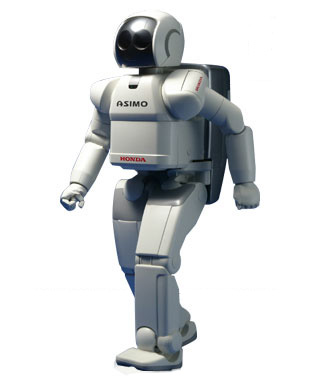
Technical features of the robot are: it is capable of running at a speed of six km an hour, walking between three and five km an hour and turn at five km an hour. It is one metre and thirty centimetres high and its weigh is fifty-four kg.
It has sensors in its wrists to transport objects as boxes, carts, etc in a safe way.


Petman.

Petman is an android developed by Boston Dynamics and it will be destined to test certain chemical military clothes for U.S. Soldiers.

It is a more advanced than Asimo in motion systems; it balances itself and moves freely walking, running, crawling, jumping, pushing, pulling... Petman imitates humans body in its physiology characteristics too; it can control its temperature, humidity and sweating whether ordered or not. The realistic configuration of Petman is due to its labour that consisted in test certain human clothes in real situations.

The first designings of Petman were only destined to walking operation, but recent version includes arms and is functional at all. It has cost 13 months designing and 17 building. Now it belongs to the U.S. Army. Many people believe that this robot will be the father of the first generation of robot soldiers.

Industrial robots.
MovemasterEX (Mitsubishi´s).
There are thousands of industrial robots in the whole world. Factories employed typical mechanic-arm models for universal works, but only them are industrial robots; there are many kinds of specific operations robots. Then, do not understand these robots as only one group.


Even though many sorts of these machines exist, we take only one example of them, a classic robotic arm design, an “Industrial Micro-robot System Model RV-M1” , the
Mitsubishi robot model RV-M1 MovemasterEX.

This robot consist of a robot unit (the arm only), a mechanic hand (independent from the arm), a motion unit (that is the specific computing support) and a command keyboard. All the system must be connected to a personal computer, from which the user can interact with the device.

It has four freedom degrees in the mechanic arm and a variable number of them in the hand (the hand can be changed to different functions). It can rotates 300 degrees around. It can charge 1 kg, is very efficient and speedy.

MovemasterEX can develop almost any operation it is ordered: manipulate objects moving on a conveyor belt, follow programmable actuation routines, be controlled by the computer support or a human operator from a PC, etc. It is able to interact with other MovemasterEX units by special interfaces and communicate to the PC that controls it.

On the other hand certain specific works require certain sorts of robots. Some enterprises offer very variate machines that they use to classify in:
  • Small robots.
  • Light weight charges robots , that manipulates objects between 5 and 15 kg.
  • Medium weight charges robots, that manipulates objects between 30 and 60 kg.
  • Heavy weight charges robots, that manipulates objects between 80and 300 kg.
  • Very heavy weight charges robots, that manipulates objects between 300 and 1300 kg.
  • Construction special model robots, that develops specific works in the industry.

Investigation robots: flexible robot.
Harvard´s University Flexible Robot.
The new robot made by the University of Harvard in U.S.A. is a machine based in squids´ and octopus´ structure. Exactly as this animals do, it crawls, curls, slips away...
This robot´s capabilities overcomes classic mechanical robots (with wheels, methal parts, etc.); it is able to walk for every surface without obstacles.


Detailed information about is tell us that it is made of elastomer plastic, which is a special flexible material. Inside the elastomer body, there are some structures as balloons are blown up to make the robot to move.

Different administration of the gas that is put inside the robot make it move its legs in a certain way. Some experiments has tested its capabilities and its capable of displace under narrow obstacles crawling or walk over them climbing. This machine has another advantage, like it can crash or be hit and not break.

Monday, February 27, 2012

4. Classification of Robots, definition of the principal technicalities, Robots´ features and advantages and disadvantages of them


Classification of Robots.

The quality, the flexibility and the level of movement freedom of robots depend of the power of their software, how developed their mechanic parts are and the capacity of the sensors or detectors, so it is not weird that, in such a great world of possibilities, there are many kinds of robots. (*We are not going to include application classification in this paragraph, but in the “Real applications of future prospects” paragraph*)
The first kind of robots that we can do is about their capacity to act and think, a general classification. It means how intelligent they are and how they can apply it to their operation:
  • Manual control robots: they are devices controlled by somebody, so many machines can be exampled: drills, remote control cars, cars, etc. This sort of robots is the most confusing because not everybody agrees with it; these people think manual control robots are simple machines.
  • Play-back robots or fixed sequence robots: they are robots who follows a determined succession of orders or commands not changeable. This sort of robots are called “opened loop control” robots, which means that these machines receive stimulus from the environment but they do not change their behaviour, they continue doing the same.
  • Variable sequence robots: they follow a succession of orders or commands and they continue doing them unless a human change the sequence to make the robot have a different behaviour.
  • Numeric control robots: these robots are controlled by a program which is saved into a hardware device (a CD, a pen-drive, hard drive, etc) and humans can select or change the program they want the robot to follow.
  • Intelligent robots and Artificial Intelligence robots: the most complex and developed sort of robots. They are robots with a “closed loop control” and it means that they are able to receive stimulus from the environment to process the information and then give an answer according to their program.
In this group Artificial Intelligence robots are included; these are robots whose have been programmed trying to make them intelligent, we mean they are able to have a intelligent behaviour.

Now, another possible classification is the programming systems´ ones, the level of the programming language employed. The key for the application of to a great variety of works is the development of the high level programming languages. Despite we can use many programming languages to program a robot, the most advanced ones belong to investigation laboratories. The programming systems classification is the next one:

  • Guided systems robots: the user guide the robot in its activity throw the movements that he makes. The robot obey the human orders while this one is giving them to it.
  • Level-robot programming systems: the user has to write a computer programming when he indicates movements and sensors actuation.
  • Level-work programming systems robots: robots operations are specified by the user by the actions that this one do with things that are being manipulated by the robot at the same time.

Finally, the last classification we can do of robots is about their mechanic parts, their architecture. The architecture of a robots is the general configuration that they have, which can be anyone depending of their work capacities. The final classification is the next one:
  • Several-joints robots/ poly-articular robots: they have got many different shapes and configurations and their principal characteristic is that they are sedentary, although they sometimes can be guided in short displacements. In this group robots with a limited number of degrees of freedom are included; they work a limited area and are used to manipulate objects. Some examples are industry´s robotic arms, and Cartesian robots ( machines that work classifying, packing, selecting or build many similar things serially ).
  • Mobile robots: they can move on their own by using wheels. They take information from the environment using sensors or are guided by a remote control. In industry, they are used to transport materials and things inside the factory; they can follow electromagnetic lines drawn on the floor to go away, they can detect obstacles.
  • Animal configuration robots: they are robots which employ mechanic parts, that are similar to animals´ ones, to their displacements. Animal robots, although they can be stative, usually have got the capacity to move and many of them have been made for spacial exploration on the ground and in seas´ and volcanoes´ exploration.
  • Humanoid robot/ androids: this kind of robots are made trying to imitate humans´ way to move, their behaviour and intelligence. The extremely complexity of human body makes difficult the construction of enough developed androids, so all humanoid robots are just investigation experiments not really useful.
  • Hybrids robots: these are robots that share characteristics of two or more sorts of the other ones. They are designed to determined purposes such as industry’s´ specific products, educational uses or military uses.
  • Nano-bots: microscopic robots not enough developed yet. They are used in some medical treatments and experiments for future possibilities.
  • Cyborgs: cybernetic organism. An alive being who has been included electromechanical parts. They are not really accepted as a kind of robot because they could be understood just as an application.
  • Automation at home systems: the science that develops indoors cybernetic and robotic systems to participate in everyday house´s day by helping their dwellers.
Robots´ features.

The idea of what a robot is.
It is true that the meaning of “robot” is not enough clear because it is a really big group of machines with similar characteristics. However, robots makers and users have determined some possible definitions according to their experience.

A robot has to be a machine or a mechanical device which works on its own following the instructions given by a human or its computer program and usually imitates animals or humans behaviour, so its operation looks intelligent or it really is. Then, a robot is often a physical machine, not a software, because a robot that only exists on a computer support is called “bot”.

Now, the official meaning of “robot” is given by the Robots Industries Association (RIA) and they say: “A robot is a programmable and multi-function handler, which is designed to move cargoes, tools, pieces or special devices, following programmed ways.”. This is the meaning of “robot” applied principally to industries´ robots. In addition, RIA´s robots share some features as they are handler machines, because they are capable to use tools and external from them objects; they can be related to the environment around them and can decide their actions in many different ways according the environment´s conditions; and they can be re-programmed to change their original functions. We can intuit one more feature, as they are machines made to replace humans in repeating jobs.

Although many machines as appliances like washer machines, dishes washer, etc they are not robots -despite we have included them in our classification- at all, because their operation does not share features of robots like possibility of displacement, or application to intelligence works.

“Programmable automatons”.
Programmable automatons are not really robots, as people may think. A programmable automaton is every electronic machine used in industry or other places to control processes and they can be controlled by anyone without electronics or computing knowledge. For example, devices like washer machine or dishes washer are programmable automatons because they work following instructions given by someone who has selected a working program before.
They are used to reduce the complexity that writing a new computer program for every action would suppose and make easier relationships between humans and electronic devices. For example, the automatic emergency stopping systems of some vehicles are programmable automatons.

Advantages and Disadvantages of Robots.

Advantages.
Robots´ main advantage is the possibility to replace humans in certain jobs, like repeating, dangerous or precision jobs.

In first place, robots are better at working than humans in works which need a great level of precision -they are nowadays better-, where humans can get tired or anything that could decrease their efficiency and success. But robots cannot, so they always do their work perfectly and this is the cause because of every industries use them in mass production making cars, medicines or appliances.
These machines can be useful in surgery too; there are some projects, like the Indiana´s University one, a robot that will be employed in precision surgical operations where it is necessary to do quick movements and act in the right way. On the other hand, some nano bots have been used in certain diseases´ treatments.
Robotics is an useful discipline to replace humans in dangerous places, such as chemistry products´ plants, construction, nuclear accidents ( for example, Japan latest earthquake one) and space exploration.

We can conclude saying that robots´ advantages are their lack of humans features ( feelings; to get bored; to be physically tired; or to be too much fragile to dangerous works) and their higher efficiency.

Disadvantages.
As many people know, the Robotics´ sector gives much employment ( investigation, selling, etc.), however, it removes more jobs, in industries, overcoat. As we have just explained, robots replaces humans because they are more efficient and profitable for companies.

Another disadvantage is the possibility of robots to become leaders of the world by their continuous increase of their capacities (not real yet) . Although the reader cannot believe this, the advances done in artificial intelligence have allowed the creation of new robots whose will be able to replicate themselves. The most complicated part of their construction would be their mechanic parts.

Most knowledgeable terms about the topic “Robotics”.

Those are the most useful terms about Robotics because the can solve many doubts about it real meaning and will help the reader to understand better the rest of the project:
  • Robot: R.I.A. says that a robot is a programmable and multi-function handler, which is designed to move cargoes, tools, pieces or special devices, following programmed ways.
  • Robotics: set of disciplines as mathematics, mechanics, electronics, computing, programming, engineering and artificial intelligence study responsible of robots designing and production.
  • Programmable automaton: every electronic machine used in industry or other places to control processes and can be controlled by anyone without electronics or computing knowledge.
  • R.I.A.: Robotics Industry Association, a very important North-American company founded in 1974 which helps engineers, managers, etc, to the robots designing and production.
  • Artificial Intelligence: the great computers´ expert John McCarthy said: “Artificial Intelligence is the science and engineering of making intelligent machines, computer programs overcoat“ .
  • Intelligent system: it is a computer program with features and behaviours similar to humans´ ones, so they could be applied to people´s life. They receive information from outside and process and save it in their memory to learn for future times and follow a determined goal. Animals, humans, etc, are complete biological intelligent systems whose are more developed than artificial ones because they have got a better capacity to get adapted to the environment.
  • Automaton: every mechanism which imitates animate beings´ actions.
  • Bot: programmable computing system which works automatically doing some works on the computer support only. It is important to know that “bot” is a functional system without any physical utility which can be, for example an edition program of a web page, a server´s helper, etc.

3. Brief history of Robotics


For a long time, humans have built machines that mimic the human body parts. The ancient Egyptians were capable of uniting mechanical arms of the statues of t heir gods and Greeks built statues operating with hydraulic systems.
During the seventeenth and eighteenth centuries in Europe built very ingenious mechanical dolls that had some characteristics of robots.
Jacques de Vauncansos built several robots human-sized players in the mid-eighteenth century.
In 1805, Henri Maillardert made a mechanical doll that was able to draw pictures with different technologies.
Karel Capek, a Czech writer founded in 1921 the term "Robot" in his play "Rossum's labour” .The term “Robotics” was created by Isaac Asimov, defining the science of robots. Asimov also invented the Three Laws of Robotics (robots cannot act against a human being and they must not allow a human being damaged, they must obey orders given by humans unless they are in conflict with the First Law and finally the robots must protect its own existence).
Initially, we defined a robot as a reprogrammable, multifunctional manipulator designed to move materials, parts, tools or devices through a programmed series of movements to perform a variety of tasks. The development in technology has contributed to flexible automation to perform tasks within the industry. There are several factors involved in the development of the first robots in the early 50's. The artificial intelligence research developed ways to emulate human information processing with electronic computers and invented a variety of mechanisms to test their theories.
The first patents in 1946 with robots appeared very primitive machinery for transfer of Devol. Also in that year was the first computers and the first general purpose digital machine. In 1954, Devol developed the first programmable robot and introduced the term "universal controller". Engleberg Unimation called the first robotics company. The commercialization of robots begin in 1959 with the first model of the Planet Corporation which was controlled by limit switch switches .
Other important developments in the history of robotics were:
  • In 1960: introduced the first robot "Unimate" based on the transfer of items. It uses the principles of numerical control manipulator control. It was a robot with hydraulic transmission.
  • In 1961: a Unimate robot was installed at the Ford Motors Company to meet a die casting machine.
  • In 1966: Trallfa, a Norwegian firm, built and installed the first spray painting robot.
  • In 1971: "Stanford Arm”, arm a small electrically driven robot, was developed at Stanford University.
  • In 1973, SRI was developed in the first language of computer programming robots for research under the name WAVE. It was followed by the language AL in 1974.
  • In 1978: Introduced the robot PUMA (Programmable Universal Machine for Assembly) for mounting Unimation tasks, based on designs obtained in a study of General Motors.
  • In 1980: a robotic system container harvesting was the subject of demonstration at the University of Rhode Island. The system was able to capture parts random orientations and positions outside of a container by Unimation assembly tasks, based on designs obtained in a study of General Motors.
  • Between 2000 and 2011: most modern robots in the world appeared. The most advanced mechanical parts robots are made to military operations by Boston Dynamics; examples are Alpha Dog, Petman, Little Dog, etc. And the better appearance and intelligent robots have been designed by Japanese companies; examples of Japanese advanced robots are: Ishiguro, Geminoid, Asimo, etc.

Sunday, February 26, 2012

2. Concept of Robotics.


Defining robots.
Robotics is, technically, a technology science. It also can be defined as the knowledge that gives you the capacity of making automatic systems which work under some orders. Under this definition, we can put sciences like maths and electronics into Robotics. Most of robots are just something that someone did to automate a repetitive task. Most of common robots are systems which are composed of other automatons. These automatons get information from the outer world by using sensors; then, they process that information and give some orders to the other parts.

The word robot comes from the Czech term "robota", which means "hard work". The one who firstly used that term to mean automatic machines was Karel Čapek, a Czech writer. It does not only mean physical robots but also virtual robots. An example of virtual robots are the chess players, which under some rules decide whether or not is the best movement. Robots are not only the anthropomorphic machines that we can see at films; under the definition of robot previously said, robots can be rain-meters or thermometer, because they do something when something happens in the real world. That's why some writers say that a robot should be able choose between many options to be considered as a real robot. The most important writer related to robotics is Isaac Asimov. He is the one who designed the Sci-Fi rules of robotics:

1.-A robot may not injure a human being or, through inaction, allow a human being to come to harm.

2.- A robot must obey any orders given to it by human beings, except where such orders would conflict with the First Law.

3.-A robot must protect its own existence as long as such protection does not conflict with the First or Second Law.

Obviously, these laws are just conceptual, as usual at Sci-Fi. But the meaning pretty related with the AI. However, this ones only show what do these robots want to do.

Artificial intelligent concept (AI).
As you can read at the upper part, anthropomorphic machines are robots, obviously they are. But robots do not have to be anthropomorphic machines. In fact, the main use of robot is related with industry, where appearance does not have any importance. Industrial robots purpose is not really hard to understand. They can be faster than humans, and they have got more precision. And they even waste a smaller quantity of energy. After this, why robots are not used in every kind of industry? Would people accept that? In many parts of our planet, human work is cheaper than the work of robots. Many Sci-Fi writers have believed for many time that in the future, clever robots will have their own workers association and they will be legit parts of the population. And they also believe that humans will protest about that, without any success. Writers have even believed that robots will invade and conquer us. This idea comes from the fact that AI can make them smarter than us, and that was actually the only thing which puts them in a lower level of the survival scape. If they were smarter than us, wouldn't they be able to win us in a war? Many other writers think that this is a paradox. After all, how could robots become smarter than its own designer? Let's make a fast and deep summarize about AI.

As we can imagine, AI is the intelligence made by humans, the one which robots utilize. These ones come from the computer science and can be defined as "The study and design of intelligent agents". These agents my vary; for example, if we have got a robot which looks for a line and follows it, we can say that we have got an intelligent agent. Today, many people and many organisations are researching AI, probably because it i's an idea which could change people lives -and boss economy-. AI started as a way to reason with maths. Many philosophers have been thinking about it, but only one person could make real advances. He was Alan Turing, and created the actual way of thinking of computers based in 0 and 1, mostly called binary. Using binary and Boole's algebra, we can create conditional sentences for robots. Let's see an example of an intelligent behaviour based in C language:

(numberOfEnemies<=20)?(runLikeUsainBolt()):(killThemAll())

Here we have used a simple conditional, but we can also create OR and AND logical sentences.

Or:
((numberOfEnemies<=20)||(sizeOfEnemies<=300))?(runLikeUsainBolt()):(killThemAll())
AND:
((numberOfEnemies<=20)&&(sizeOfEnemies<=300))?(runLikeUsainBolt()):(killThemAll())

In the first sentence, we can see that if one thing is real, another thing happens. In the 2nd one, if one of the things in the sentence is real, even if both are real, something will happen. In the 3rd sentence, only if everything is true, the consequence will happen. Boolean algebra can give machines the capability of reasoning in a simple way. Some scientists believed in the past that humans use that way of reasoning. Well, that is not true. Humans mind does not calculate everything every time. It uses to choose things by past experience. For example, our creativity mixes past experiences, so if a human mind wants to know what will happen after an event, it remembers what happened before and doesn't calculate what will happen. As a consequence, researchers are trying to know how does human mind really works to create an artificial brain.
And we cannot finish talking about the robotics concept without talking about the actual concept of computation related to robots, the way they work. Let's create a virtual system where we have a 20*20*20m cube. Into the cube there's a piece of wood, a circle. Under the circle we've got two motors which are connected to a protoboard which is on the circle. Two photo-sensors are in the front of the circle, and these ones are connected with the protoboard. The control circuit sends an electric signal to the photo-sensors. These ones let energy pass if they receive light, and if there's a object in front of the sensor, the photo-sensors receive light. The control circuit were programmed previously, and the programmer set the control circuit to make the right motor move if it receives signal from the photo-sensor. If the right photo-sensor sends the signal, the left motor has to move. It looks really simple, but is it really simple? No, it isn't. We'll talk later about the mechanical parts that a robot is made of. We are going to get concentrated on the control circuit. The control circuit is usually a micro-controller and some other electronic parts that may vary if the robot does one or another function. This micro controllers are integrated circuits. They concentrate many components and conductors, and they're silicon made. Their way of working is quite complicated, we are going concentrate in the computation side of micro-controllers. When they receive an electrical signal, they do whatever they're programmed for. They've got many pins, and every pin as a specific function. They're programmed in a low level programming language, the assembler. When a programmer puts some code into the micro-controller, the assembler is translated into binary code, a code that a micro-controller can understand. This micro-controller works in a digital way: the micro-controller can understand 1 and 0. Many micro-controller cards, like “Arduino”, can make analogical signals by dividing the main signal into time, so there's no need to modulate. It can understand, in a digital way, signals from 0 to 1. It also can understand, in an analogical way, signals from 0 to 1023, so it can understand what in binary would be 1111111.


Unemployment and robots.
Many writers think that, in the future, robots will get people's job and no one will be able to get money because robots are cheaper. No, that is not really true. Robots are, obviously, a way to get more money because they are more efficient, but robots do not repair themselves. They do not design themselves and, by the moment, they cannot have "creative" reasoning. The develop of robots needs people to improve them, to design them, to test them, to repair them... Another main reason is that the people who is at industries right now are also buyers. Let's propose an example to show this basic principle of economy. A man B assemblies two shoes per hour and buyers C, D and E buy 1 shoe per hour. 3 shoes per hour are bought and only 2 are made. What would happen? Probably, shoes' cost will increase but then no one would want to buy them. That definitely doesn't good for B. So he decides to employ D. D has no experience making shoes and he makes 1 shoe per hour. Now the production is 3 shoes/h and the demand 3 shoes/h.

1. Welcome, readers.

Welcome, readers, to the blog about robotics "ARS MECHANICA".
Everything about robots that you want to know will be explained in a simple and clear way in here. Stop a minute and enjoy this blog and, please, learn.