
Military robots.

Big Dog.
Military uses robots are developed the most in the United States. A prestigious company called Boston Dynamics who works for the government to investigate in military technology has be making one of the most useful robots to those objectives: Big Dog.
Big Dog is a robot designed to support marines or soldiers in the forest, in the jungle, in the snow, etc, by transporting onto it their things, gadgets, gums, weapons, food, everything they would need during a military expedition. It should have a better motion system than other vehicles like cars, lorries or tanks.
The robot was made imitating the motion systems of a four leg animal, as a dog. It has on board whatever it needs: power, actuators, control systems, sensors and communication systems. It works with a combustion engine; to its displacement, Big Dog has hydraulic actuators with oil and these ones have some aeronautical using components which give it quality; all its legs have sensors that control the position of the robot and calculates the force of the movement. It is able of jump, run and walk over every surface and inclination, in addition, it has a balance system even done, that gives him the power to correct its walking if it falls upon something or similar.
More sensors that Big Dog has are its LIDAR, stereo vision system, GPS or Ring Laser Gyro. Sight systems in Big Dog permit it scan the terrain in a radio of 30 metres, detect every obstacles, make a three-dimensional image of the area (this function in a radio a 4 metres only) and classify and guess where some obstacles could be.
The robot can maintain its body posture by controlling the different movements of its body: its standing, its lateral balance and measuring the level of contact with the ground.
On board Big Dog´s computer has a Pentium processor, a computer PC 104, an operating system QNX and it is programmed in C++.
Big Dog is capable to follow humans during a walk and obey their orders. The person who would lead Big Dog has to wear an OCU, an Operator Control Unit, which consists in a head mounted display, a 900 Mhz antenna, HMD electronics, a steering controller, a personal computer, and a 900 Mhz radio device.
Big Dog has got another descendant called AlphaDog, the most advanced robot of this series. It is capable to develop all Bog Dog´s motion capacities, but it is more than twice bigger and it is much more agile, fast and stronger. In addition, it is capable to wake up after falling down. Boston Dynamics has published videos of its operation that will surprise the reader in such an outstanding way!
Exploration robots (Space robots).
Curiosity.

Curiosity is the latest Mars exploration rover created by the National Aeronautics and Space Administration NASA .
The real name of this robots Mars Science Laboratory (MSL), but it is often called Curiosity.
It was sent to Mars the 26th of November 2011.
This robot has specific exploration functions when it will land. It is destined to discover it has been alive beings in Mars, determine the climatic conditions of Mars, study its geology and get ready a possible human travel to this planet. It is clear that its goal is getting information.
Curiosity is a sort of robot called rover. Its weight is 930 kilograms in the rough and holds about 80 kilograms more in investigation devices. On Mars surface it will be able to move at a speed of ninety meters an hour and pass over 75 centimetres high obstacles.
It works with a nuclear energy battery that is a Radioisotopes Thermoelectric Generator (RTG) which works using plutonium, producing two kilowatts and a half every day.
Curiosity has a complex vision systems that consists in a group of video cameras: one of them is “MastCam “, that is capable of take images of different spectres, full colour images and three-dimensional ones; “Mars Hand Lens Images” that is camera put on a robotic arm of Curiosity to catch microscopic images of the ground of Mars; “Mars Descent Imager” which will be employed to take pictures of the planet during the robot´s capsule landing; “Hazard Avoidance Cameras” that will detect every risks during the robots expedition; and “Navscams”, the navigation cameras which are situated on a mast on the robots back.
The other instruments are spectrometers, radiation systems, environmental sensors and atmospheric sensors:
Spectrometers are: APXS, Alpha Particle X-Ray Spectrometer that will measure the quantity of chemical elements in the rocks and other things by, simply, emitting X-rays a sort of electromagnetic radiation- and detecting the characteristic answer of the surface; ChemCam which is a laser producer that throws a laser ray that vaporizes certain materials and then identify the elements by emission of plasma generated; CheMin -Chemistry and Mineralogy instruments-; and SAM -Sample Analysis at Mars instrument-. Radiation detectors are the Radiation Assessment Detector (RAD) and the DAN. Environmental sensor is the REMS, the Rover Environmental Monitoring Station , that has a device developed by Spanish government called the CAB (the “Centro de Astrobiología”). Finally, the atmospheric sensor is called MEDLI.
Curiosity has inherited many displacement devices from its predecessor, Mars Exploration Rover. It have a six wheels drive, rocker-wagon suspension system and all navigation machines (Navscams and other ones). The mobility system is quite similar to the predecessor and is compact.
Androids, humanoid structure robots: “Asimo” and “Petman”.
Asimo.
Asimo, “Advanced Step and Innovate Mobility” robot, is an android -a robot similar to human beings- developed by the multinational Japanese company Honda in 2000.
Asimo is a robot made for people relationships: interacting with humans, helping them, etc. However, the difficulties that the complexity of humans behaviour supposes make this robot not able to do its work at all, then, it is employed to advertisement labours. It is one of the most advanced human robots in the world because it imitates many human movements as running, walking, jumping, crawling or turning. Asimo has some Artificial Intelligence appliances like identifying and catching objects, understanding and answering oral orders and recognize people faces. It has been added a communication system (RC IC) that permits him know where people are without looking at them.
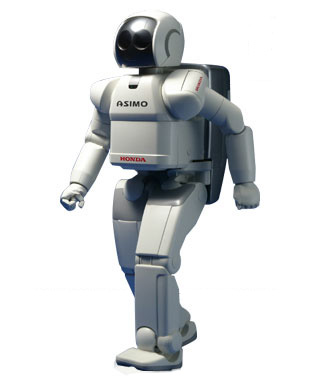
Technical features of the robot are: it is capable of running at a speed of six km an hour, walking between three and five km an hour and turn at five km an hour. It is one metre and thirty centimetres high and its weigh is fifty-four kg.
It has sensors in its wrists to transport objects as boxes, carts, etc in a safe way.
Petman.
Petman is an android developed by Boston Dynamics and it will be destined to test certain chemical military clothes for U.S. Soldiers.
It is a more advanced than Asimo in motion systems; it balances itself and moves freely walking, running, crawling, jumping, pushing, pulling... Petman imitates humans body in its physiology characteristics too; it can control its temperature, humidity and sweating whether ordered or not. The realistic configuration of Petman is due to its labour that consisted in test certain human clothes in real situations.
The first designings of Petman were only destined to walking operation, but recent version includes arms and is functional at all. It has cost 13 months designing and 17 building. Now it belongs to the U.S. Army. Many people believe that this robot will be the father of the first generation of robot soldiers.
Industrial robots.
MovemasterEX (Mitsubishi´s).
There are thousands of industrial robots in the whole world. Factories employed typical mechanic-arm models for universal works, but only them are industrial robots; there are many kinds of specific operations robots. Then, do not understand these robots as only one group.
Even though many sorts of these machines exist, we take only one example of them, a classic robotic arm design, an “Industrial Micro-robot System Model RV-M1” , the
Mitsubishi robot model RV-M1 MovemasterEX.
This robot consist of a robot unit (the arm only), a mechanic hand (independent from the arm), a motion unit (that is the specific computing support) and a command keyboard. All the system must be connected to a personal computer, from which the user can interact with the device.
It has four freedom degrees in the mechanic arm and a variable number of them in the hand (the hand can be changed to different functions). It can rotates 300 degrees around. It can charge 1 kg, is very efficient and speedy.
MovemasterEX can develop almost any operation it is ordered: manipulate objects moving on a conveyor belt, follow programmable actuation routines, be controlled by the computer support or a human operator from a PC, etc. It is able to interact with other MovemasterEX units by special interfaces and communicate to the PC that controls it.
On the other hand certain specific works require certain sorts of robots. Some enterprises offer very variate machines that they use to classify in:
- Small robots.
- Light weight charges robots , that manipulates objects between 5 and 15 kg.
- Medium weight charges robots, that manipulates objects between 30 and 60 kg.
- Heavy weight charges robots, that manipulates objects between 80and 300 kg.
- Very heavy weight charges robots, that manipulates objects between 300 and 1300 kg.
- Construction special model robots, that develops specific works in the industry.
Investigation robots: flexible robot.
Harvard´s University Flexible Robot.
The new robot made by the University of Harvard in U.S.A. is a machine based in squids´ and octopus´ structure. Exactly as this animals do, it crawls, curls, slips away...
This robot´s capabilities overcomes classic mechanical robots (with wheels, methal parts, etc.); it is able to walk for every surface without obstacles.
Detailed information about is tell us that it is made of elastomer plastic, which is a special flexible material. Inside the elastomer body, there are some structures as balloons are blown up to make the robot to move.
Different administration of the gas that is put inside the robot make it move its legs in a certain way. Some experiments has tested its capabilities and its capable of displace under narrow obstacles crawling or walk over them climbing. This machine has another advantage, like it can crash or be hit and not break.

No comments:
Post a Comment